Pickleball Serve Consistency: One Principle Fixes Everything
You step to the line. Same starting position. Same motion. Same intent.
The first serve lands deep with pace and spin. The next one sails long. The third goes straight into the net. You did everything the same — so why does the ball keep going somewhere different?
According to Austin Hardy of PickleballPlaybook, the answer isn't technique. It's one principle most players never think about: your contact point.
The Principle: Your Contact Point Is Drifting
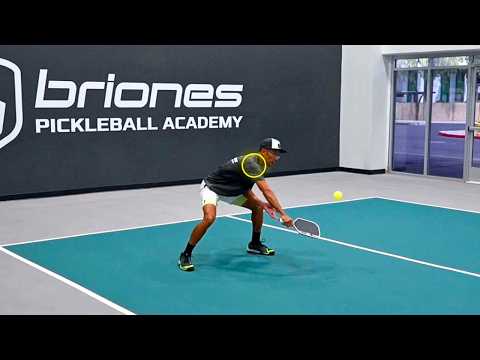
Here's the uncomfortable truth. Every time you aim at a different spot — a lefty's backhand, the middle, a deep corner — your contact point shifts slightly around the ball. Same swing, different strike zone, wildly different result.
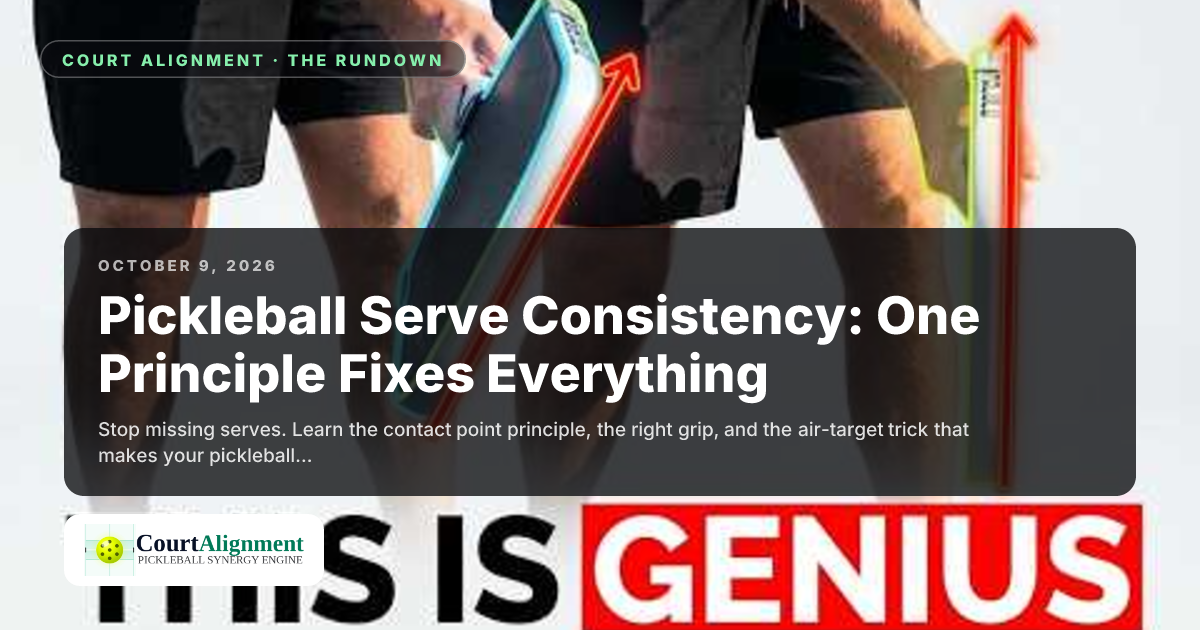
The fix is simple: keep the exact same contact point no matter where you're serving. And that starts with your grip.
The Grip That Locks In Contact
Austin uses the eastern forehand grip — also called the handshake grip — on nearly every shot he hits.
To find it: count three bevels over on your paddle handle (bevel 3) and place the base of your index knuckle there. Your paddle face should sit completely vertical at contact.
Two grips to avoid for a standard serve:
- Continental (hammer grip, bevel 2): The paddle face opens at contact. You'll lose spin and send serves long. Only use it for specific spin serves like the corkscrew.
- Semi-western (bevel 4): The face points downward. Advanced players make it work, but beginners will struggle to get the ball over the net.
If you're just starting out or want a reliable serve, handshake grip is the answer.
The Air-Target Trick That Changes Everything
Now for margin. Most players aim at a spot on the court — usually the baseline. That's a mistake. You'll miss roughly half of those serves.
Instead, aim at a spot in the air above the net.
Austin tested this live:
- Aiming 5 feet above the net → ball landed about a foot long
- Aiming 4 feet above the net → ball landed in, roughly two feet from the baseline
- Aiming 4.5 feet → landed right on the line
Four feet was his sweet spot. Yours will differ based on height, swing, and spin — but the method works the same. Pick an imaginary target in the air, and the ball naturally lands where you want it.
The Motion: Draw a C
Once your grip and target are set, the swing is almost effortless.
Bring the ball and paddle together at a point in line with your knee. Keep your non-dominant arm steady. Then draw a C — or a Nike swish — accelerating as you come through, finishing over your shoulder.
That's it. The serve really is that simple.
Your Homework
- Switch to the eastern forehand grip.
- Go drill 20 serves aiming at 4 feet above the net.
- Adjust by 6-inch increments until you find your perfect height.
Then drill it until it's automatic. Consistency doesn't come from more tips — it comes from reps with the right principle.
Watch the full breakdown from PickleballPlaybook – Austin Hardy to see the drill in action.